On November 1, 2024, supported by Peking University’s "Graduate Education Innovation Program", the first "Guangdong-Hong Kong-Macau" Greater Bay Area AI for Science Doctoral Academic Forum kicked off in the Lecture Hall of Building D at Peking University Shenzhen Graduate School. Attendees included Academician Xu Zongben of the Chinese Academy of Sciences (a mathematician and expert in signal and information processing from Xi'an Jiaotong University), Professor Tan Wenchang (Party Secretary of Peking University Shenzhen Graduate School), Associate Professor Mo Fanyang (tenured, School of Advanced Materials, Peking University Shenzhen Graduate School), Associate Professor Chen Jie (School of Electronic and Computer Engineering, Peking University Shenzhen Graduate School), Assistant Professor Yuan Li (School of Electronic and Computer Engineering, Peking University Shenzhen Graduate School), and over 100 doctoral students from universities such as the University of Hong Kong, The Chinese University of Hong Kong, Hong Kong Baptist University, Macau University of Science and Technology, Macau University of Science and Technology, Peking University, Tsinghua University, Sun Yat-sen University, Southern University of Science and Technology, and Shenzhen University. The forum was hosted by Professor Tian Yonghong, Assistant to the Dean of Peking University Shenzhen Graduate School and Dean of the School of Electronic and Computer Engineering.
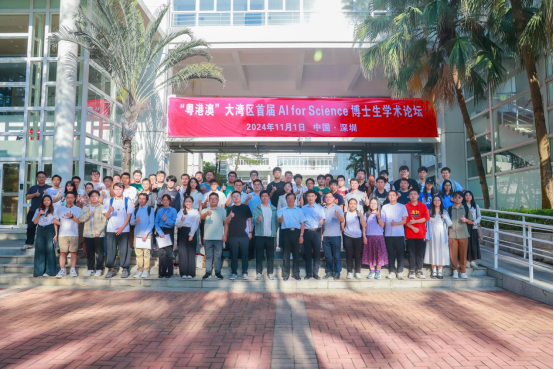
Group Photo
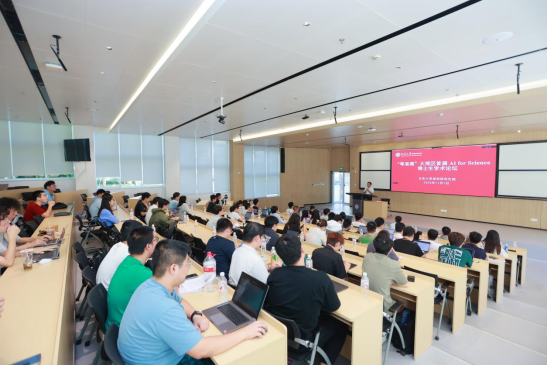
Scene of the AI for Science Main Forum
On behalf of Peking University Shenzhen Graduate School, Professor Tan Wenchang expressed sincere gratitude and warm welcome to the guests and students attending the forum. He stated that under the guidance of the development philosophy of "problem-oriented, north-south linkage, AI-driven, and innovative integration", the Shenzhen Graduate School has made scientific intelligence (AI for Science/AI4S) a priority development strategy, applied for the addition of an interdisciplinary subject in scientific intelligence, and actively explored the cultivation of high-level talents with interdisciplinary backgrounds and AI research capabilities. He hoped that this forum would provide a platform for students to learn from each other and showcase themselves, and that young scientists and students would follow the example of older generations of scientists in their hard work, delve into the vast field of AI4S interdisciplinary subjects, courageously act as pioneers and strive to be leaders, uniting their efforts for scientific and technological self-reliance and national rejuvenation.
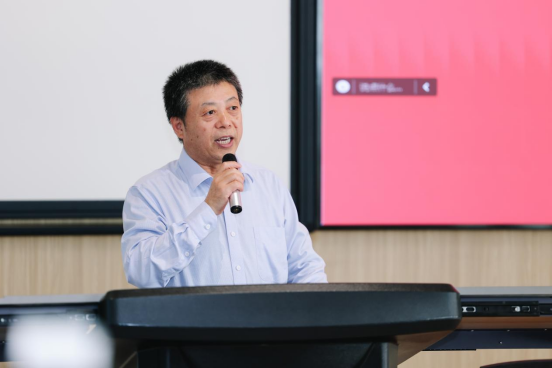
Speech by Secretary Tan Wenchang
Academician Xu Zongben delivered an academic report titled "Limit Theory of Large Models: Interpreting the Phenomenon of Intelligent Emergence", analyzing questions such as: What is intelligent emergence? What factors contribute to intelligent emergence? Under what conditions do large models exhibit intelligent emergence? The report proposed a mathematical framework, with the core idea of using a ternary random function ℰ(N,P, ∂ℓ) to measure the generalization of large models, and using the limit behavior/limit speed of ℰ(N, P, ∂ℓ) (N→∞, P→∞, ∂ℓ→0) to measure the scaling law of large models, based on which to interpret intelligent emergence. He stated that the scaling law between the generalization performance of large models and model size lies between sub-exponential and exponential rates; the scaling law between the generalization performance of large models and the size of training data is sub-exponential; when the weights of large models are optimally set and their building blocks satisfy Lip(T) < 1 or m(A) > 0 (where Lip(T) and m(A) are the Lipschitz number and Dahlquists number of the large model building blocks, respectively), the model size and training data size approaching infinity will lead to the emergence of intelligent emergence in large models.
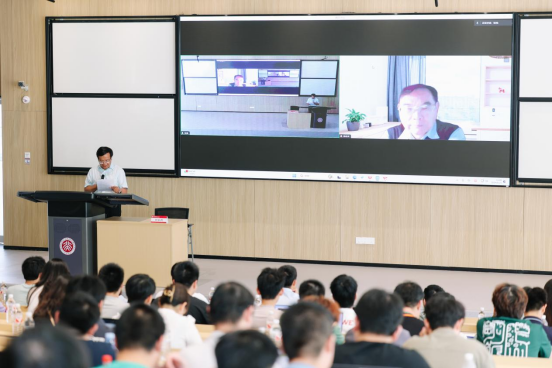
Academician Xu Zongben delivering an online academic report
The AI for Materials sub-forum consisted of a report by Associate Professor Mo Fanyang and oral presentations by 5 doctoral students, covering topics such as compound chromatographic separation, molecular simulation, and infrared spectrum prediction models.
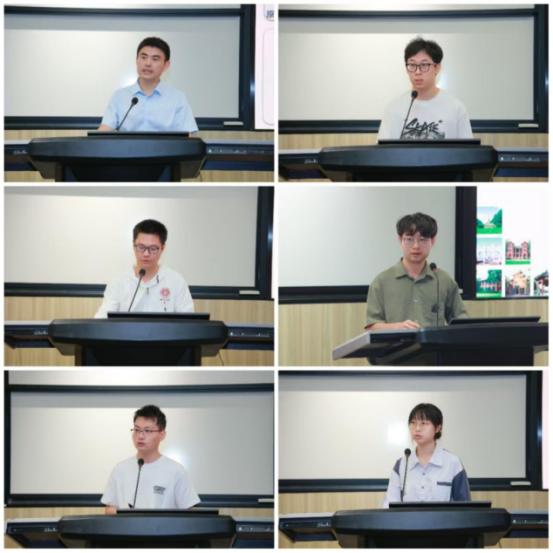
Presenters at the AI for Materials sub-forum (Mo Fanyang, Cui Taoyong, Lai Genming, Chen Zhe, Liu Chengjun, Zhang Ruiqi)
Associate Professor Mo Fanyang delivered a report titled "Machine Learning-Assisted Compound Chromatographic Separation", detailing the challenges of separating chemical synthesis products and the limitations of chromatographic technology. He noted that manual compound chromatographic separation is time-consuming and labor-intensive, while the establishment of AI large models can greatly improve the accuracy and convenience of chromatographic separation.
Cui Taoyong from Tsinghua University gave a report titled "Geometry-enhanced Pretraining on Interatomic Potentials", sharing his work on using machine learning for material design and drug development.
Lai Genming from Peking University delivered a report titled "Analysis of Li Metal Anode by Machine Learning Potential", sharing the application of artificial intelligence technology in lithium deposition mechanisms, lithium dendrite regulation, and lithium deposition on copper structures, providing ideas for improving the performance of lithium metal anodes in the future.
Chen Zhe from Sun Yat-sen University, with the title "Automate Reaction Exploration and Machine Learning Guided Catalyst Discovery", introduced innovative achievements in using artificial intelligence technology to screen active catalysts and verify them through experimental synthesis.
Liu Chengjun from Peking University gave a report titled "Infrared Spectra Prediction for Functional Group Region Utilizing a Machine Learning/Neighboring Mechanism", proposing a machine learning method that adopts a structural neighboring mechanism aimed at enhancing the prediction and interpretation of infrared spectra, thereby significantly improving the accuracy, robustness, and interpretability of spectral prediction.
Zhang Ruiqi from Peking University delivered a report titled "Machine Learning for Screening Stable Structures and Elucidating Doping Effects on", introducing work on using artificial intelligence technology to further improve the energy density of cathode materials and reduce costs.
The AI for Biology sub-forum included a report by Associate Professor Chen Jie and oral presentations by 5 doctoral students from Peking University, The Chinese University of Hong Kong, and Sun Yat-sen University, covering hot topics such as protein design, multi-omics data integration, protein complex structure modeling, and tumor microenvironment cell analysis.
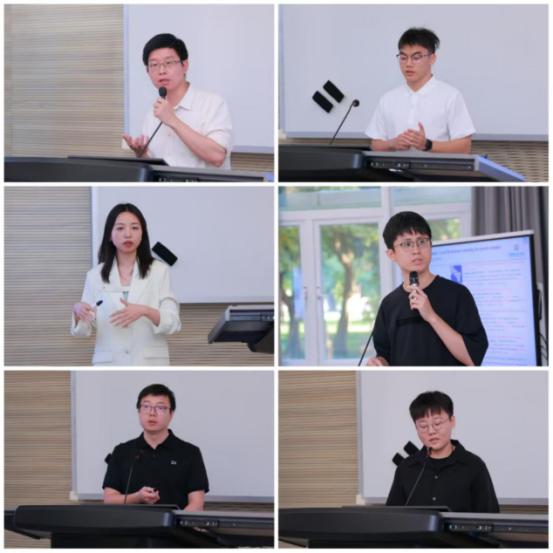
Presenters at the AI for Biology sub-forum (Chen Jie, Lin Zongying, Jiang Tao, Chen Sheng, Xiong Xin, Zhang Yikun)
Associate Professor Chen Jie delivered a report titled "Big Data-Driven Scientific Paradigm for Protein Design", introducing research work on protein drug design based on AI large models and demonstrating that artificial intelligence has opened up a new scientific paradigm in the field of protein design.
Lin Zongying from Peking University shared a topic titled "Taxonomy-Guided Protein Sequence Diffusion Model", proposing a taxonomy-guided diffusion model TaxDiff for controllable protein sequence generation that combines biological species information, using the generative ability of diffusion models to generate proteins within the sequence space of structurally stable model sequences.
Jiang Tao from The Chinese University of Hong Kong gave a report titled "MetaGXplore: Integrating Multi-Omics Data with Graph Convolutional Networks for Pan-cancer Patient Metastasis Identification", sharing work on enhancing the interpretability of AI models and identifying key gene metastases related to AI models, providing new insights for future targeted therapy.
Chen Sheng from Sun Yat-sen University delivered a report titled "Protein Complex Structure Modeling by Cross-Modal Alignment between Cryo-EM Maps and Protein Sequences", opening a new path for protein complex structure modeling by adopting a more global approach to predict amino acid types and aligning cryo-EM maps with protein sequences through cross-modal alignment.
Xiong Xin from Hong Kong Baptist University gave a report titled "DeSide: A Unified Deep Learning Approach for Cellular Deconvolution of Tumor Microenvironment", providing a unified deep learning method for cellular deconvolution of the tumor microenvironment and bringing new directions to tumor research.
Zhang Yikun from Peking University delivered a report titled "Multiple Sequence Alignment-Based RNA Language Model and Its Application to Structural Inference", demonstrating the application of a multiple sequence alignment-based RNA language model in structural inference and injecting new technical momentum into the field of RNA research.
The AI for Informatics sub-forum consisted of a report by Assistant Professor Yuan Li and oral presentations by 5 doctoral students from Peking University, the University of Hong Kong, and Shanghai Jiao Tong University, covering hot topics such as AIGC video generation, anomaly detection, semantic communication, copyright protection, and embodied intelligence.
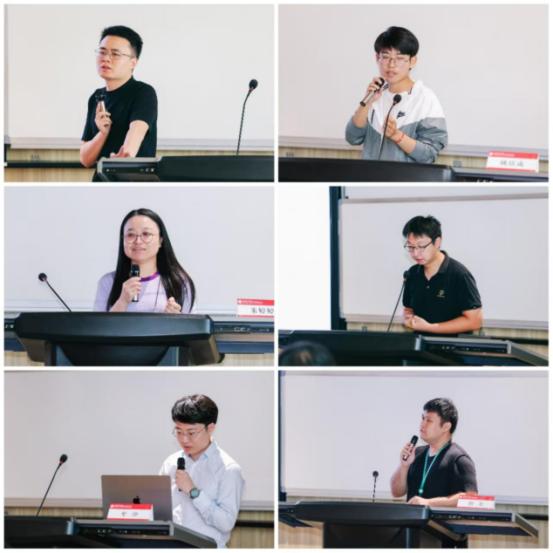
Presenters at the AI for Informatics sub-forum (Yuan Li, Yao Xincheng, Zhu Tingting, Zhang Xuanyu, Mou Chong, Mu Yao)
Assistant Professor Yuan Li delivered a report titled "Generation Does Not Necessarily Mean Understanding: From Open-Source Video Generation Models to a Unified Architecture for Understanding and Generation", introducing work on AIGC video generation. He pointed out that current video understanding is basically converging to autoregressive models, while generative architectures have not yet converged to diffusion models. The separation of these two modeling methods is a major problem faced by current open-source video generation models and also a vast field for scientific researchers to explore.
Yao Xincheng from Shanghai Jiao Tong University gave a report titled "ResAD: A Simple Framework for Class Generalizable Anomaly Detection", discussing class-agnostic anomaly detection methods. By cleverly using residual features, he first matched each class with the most similar class-related attributes and then used subtraction to offset class correlations, eliminating the impact of class correlations on results and achieving simple and effective anomaly detection.
Zhu Tingting from Sun Yat-sen University delivered a report titled "How to Evaluate Semantic Communications for Images with ViTScore Metric?", proposing a communication effect evaluation metric based on the ViT model in the context of information transmission shifting from traditional bit communication to semantic communication, which can be widely applied to multiple levels such as classical image communication, image semantic communication, and noisy image semantic communication.
Zhang Xuanyu from Peking University shared a topic titled "EditGuard: Versatile Image Watermarking for Tamper Localization and Copyright Protection", creatively proposing a solution of embedding dual watermarks into images to address the problem that generated content cannot be judged by humans in the AIGC era.
Mou Chong from Peking University gave a report titled "T2I-Adapter: Learning Adapters to Dig Out More Controllable Ability for Text-to-Image Diffusion Models", introducing work on precise and controllable generation based on diffusion models and precise image and video editing. He creatively proposed the idea of adding an adapter called T2I-Adapter, which can be plug-and-play and combined for application without affecting the generation effect, achieving precise editing of generation results.
Mu Yao from the University of Hong Kong shared a topic titled "RoboCodeX: Multimodal Code Generation for Robotic Behavior Synthesis", introducing new progress in the field of embodied intelligence. He used visual language models to construct 3D world coordinate maps, defined possible interaction preferences of objects and physical constraints in the real world, and used large models for specific inference to achieve the interaction between robots and real objects.
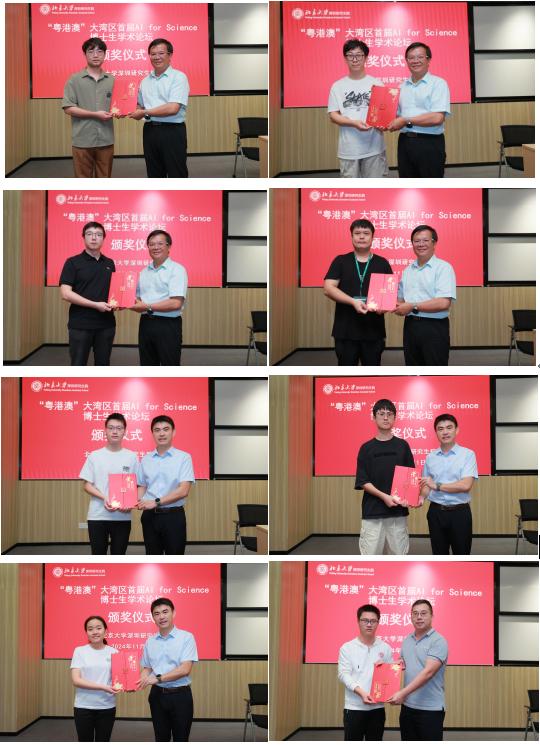
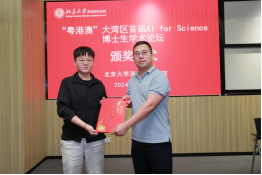
Professor Tian Yonghong, Professor Mo Fanyang, and Professor Tan Mingkui presenting awards to winning students
The forum also selected three types of awards: Excellent Thesis, Excellent Poster, and Excellent Speaker. Cui Taoyong won the first prize for Excellent Thesis; Zhang Yikun and Mou Chong won the second prize for Excellent Thesis; Ren Hengyu and Lai Genming won the third prize for Excellent Thesis; Liu Chengjun, Chen Sheng, Zheng Zhenxiang, and Yang Rui won the Excellent Poster Award; Chen Zhe, Xiong Xin, and Mu Yao were named Excellent Speakers.